



The hunt for the next AI-adjacent breakout has moved well beyond the usual chip giants. Traders are now chasing smaller, more specialized corners of the semiconductor market – and one little-known memory stock has suddenly become impossible to ignore.
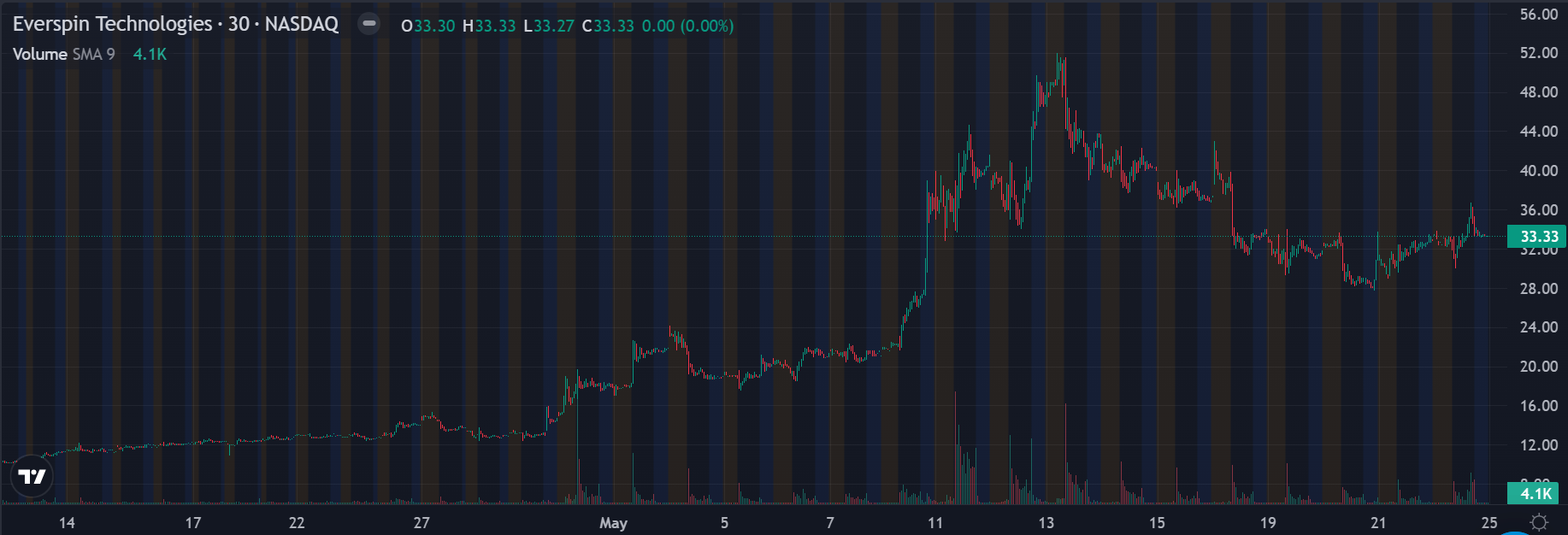
Shares have ripped from about $13 to $33 in a month. For most stocks, that kind of move would make traders question whether the rally has already gone too far. Recent options activity suggests some traders aren’t asking that question at all.
Instead, they’re betting on another monster leg higher – in a company that sits at the intersection of AI infrastructure, defense electronics, and resilient computing. And the size of that bet is hard to ignore.
That stock is Everspin Technologies (MRAM), a small-cap semiconductor company focused on magnetoresistive random access memory. With shares around $33, the December $65 calls recently traded for $9.60 – putting the breakeven at roughly $74.50, more than double the stock price at the time of the trade. That is not a modest momentum trade. It is a wager that this rally has a long way left to run. This is exactly the kind of unusual options activity that Benzinga Pro’s Options tool is built to surface before it becomes part of the broader market conversation.
What Everspin Does – and Why It Matters
Most memory stories are about speed, scale, and cost. Everspin’s story is about resilience.
Its technology – magnetoresistive random access memory, or MRAM – is designed to keep critical data intact when systems lose power, reset unexpectedly, or operate in environments where failure is not an option. That puts Everspin in a specialized corner of the memory market. MRAM is not built to replace mainstream DRAM or NAND flash. It is built for applications where memory needs to be fast, durable, and persistent – meaning it retains data even when power is lost.
That makes MRAM relevant in systems where data loss is not merely inconvenient but potentially unacceptable: industrial automation, transportation, aerospace, defense systems, data center infrastructure, and other high-reliability environments where continuity matters more than the lowest possible cost per bit.
That distinction helps explain why the stock has started to attract serious attention. The defense angle, in particular, has changed how investors think about the company. Everspin announced a 2.5-year, $40 million agreement with a U.S. prime contractor tied to military and aerospace applications. For a company of this size, that is not a small headline. It signals that MRAM may be moving from niche component to strategic capability in markets where domestic supply, reliability, and qualification carry real weight.
The company also has longer-term product optionality. Its PERSYST STT-MRAM family is designed to expand the addressable market with higher-density solutions, while UNISYST targets high-density standalone NOR flash opportunities. Those products are still part of a longer roadmap, not an immediate earnings engine – but they help explain why the market is starting to view Everspin as more than a sleepy specialty chip supplier.
Benzinga Pro’s Signals can help you track how institutional positioning shifts as that product roadmap develops.
Earnings Gave the Rally Something Tangible to Work With
Everspin’s first-quarter results gave traders something to measure after the stock’s sharp run. The numbers do not fully explain the rally by themselves – but they help explain why the market is taking this story more seriously.
Revenue came in at $14.9 million, up 14% year over year and near the high end of guidance. More importantly, MRAM product sales rose 28% to $14.1 million, showing that the core chip business is doing the heavy lifting. Licensing, royalty, patent, and other revenue fell to $0.8 million from $2.1 million a year earlier, but the product-sales growth helped offset that pressure.
Gross margin also moved in the right direction. GAAP gross margin rose to 52.7%, up from 51.4% in the prior-year period, supported by higher utilization and cost reductions. For a company trying to earn a higher strategic-memory multiple, that matters. The market may tolerate some volatility in a small-cap technology story, but it still wants evidence that revenue growth can scale without margin deterioration.
The balance sheet remains another point of support. Everspin ended the quarter with $40.5 million in cash and no debt. Cash flow from operations was modest at $0.5 million, down from $2.6 million in the previous quarter, partly because of litigation costs and working capital needs.
Guidance was more mixed. For the second quarter, management guided revenue to a range of $15.5 million to $16.5 million – but also guided for a GAAP net loss of $0.12 to $0.07 per share, with non-GAAP results ranging from breakeven to net income of $0.03 per share.
That is the trade-off. Everspin has better product momentum, a stronger defense narrative, and a more strategic memory story than it had a few quarters ago. But it is still a small company with uneven profitability, litigation expenses, and a revenue base that needs to grow meaningfully to support the stock’s new valuation. Set a Benzinga Pro Alert on MRAM so you don’t miss the next earnings print – or any defense contract announcement that moves the stock before then.
The Stock Has Re-Rated. Now the Numbers Have to Catch Up.
Everspin is no longer being priced like an overlooked niche semiconductor stock. The market has started treating it like something more strategic: a specialized memory company tied to defense electronics, AI infrastructure, and resilient computing. That framing may be fair – but it also raises the stakes.
The valuation now reflects a much bigger story than the current revenue base. Everspin trades around 82 times forward non-GAAP earnings, compared with a sector average closer to 25 times. The stock also trades at roughly 13 times sales and about 11 times book value, versus a sector average closer to 4 times on book value. Investors are already paying for a meaningful step-up in growth.
That does not automatically make the stock uninvestable. Small-cap momentum names tied to powerful themes can hold premium valuations longer than skeptics expect – especially when the story involves domestic semiconductor capacity, defense applications, and AI-adjacent infrastructure. But it does mean the bar is much higher. At the current price, Everspin needs more than incremental progress. It needs continued product growth, better operating leverage, stronger margin performance, and evidence that defense and high-reliability design wins can become repeatable revenue streams, not just one-time catalysts.
Analyst coverage is also thin, which makes the recent move harder to benchmark. Only two analysts cover the stock, and both rate it a buy – but the average price target is around $18, well below the recent share price near $33. That does not mean analysts are right and the market is wrong. It does show how quickly the stock has moved beyond the existing Wall Street framework.
That is what makes the December $65 calls so aggressive. The trade is not simply betting that Everspin holds its recent gains. It is betting the market keeps re-rating the company into something much larger than its current financial profile would normally support. Use Benzinga Pro’s Screener to find other small-cap semiconductor names with similar defense and AI infrastructure exposure – MRAM is not the only stock being re-rated right now.
AI and Defense Are Driving This Trade – and the Market Is Still Catching Up
Everspin has the kind of setup traders look for in a small-cap tech breakout: specialized technology, defense-related traction, AI infrastructure relevance, a debt-free balance sheet, and a chart that has already forced the market to pay attention.
AI infrastructure spending is real and accelerating. Defense electronics demand is growing. The push for domestic semiconductor supply chains is not slowing down. Everspin sits at the intersection of all three – and the market is still in the early stages of figuring out what that is worth.
That does not mean the stock is without risk. After a move this sharp, the downside is obvious: if semiconductor momentum cools, speculative AI-adjacent stocks lose favor, or the broader market weakens, MRAM could give back gains quickly. The company still needs to show that defense interest, product demand, and strategic-memory momentum can translate into sustained revenue growth, stronger margins, and more consistent profitability.
But the December $65 call activity shows some traders are already convinced. The risk is that the stock has pulled a lot of the re-rating forward. The opportunity is that if Everspin keeps turning defense interest and product demand into real numbers, the market may not be finished repricing the story.
For traders looking to stay ahead of small-cap semiconductor momentum, Benzinga Pro’s Newsfeed and Options tool are built for exactly this – real-time alerts, unusual options activity, analyst changes, and sector headlines that let you spot the next MRAM-style breakout before it becomes obvious to the broader market.


