



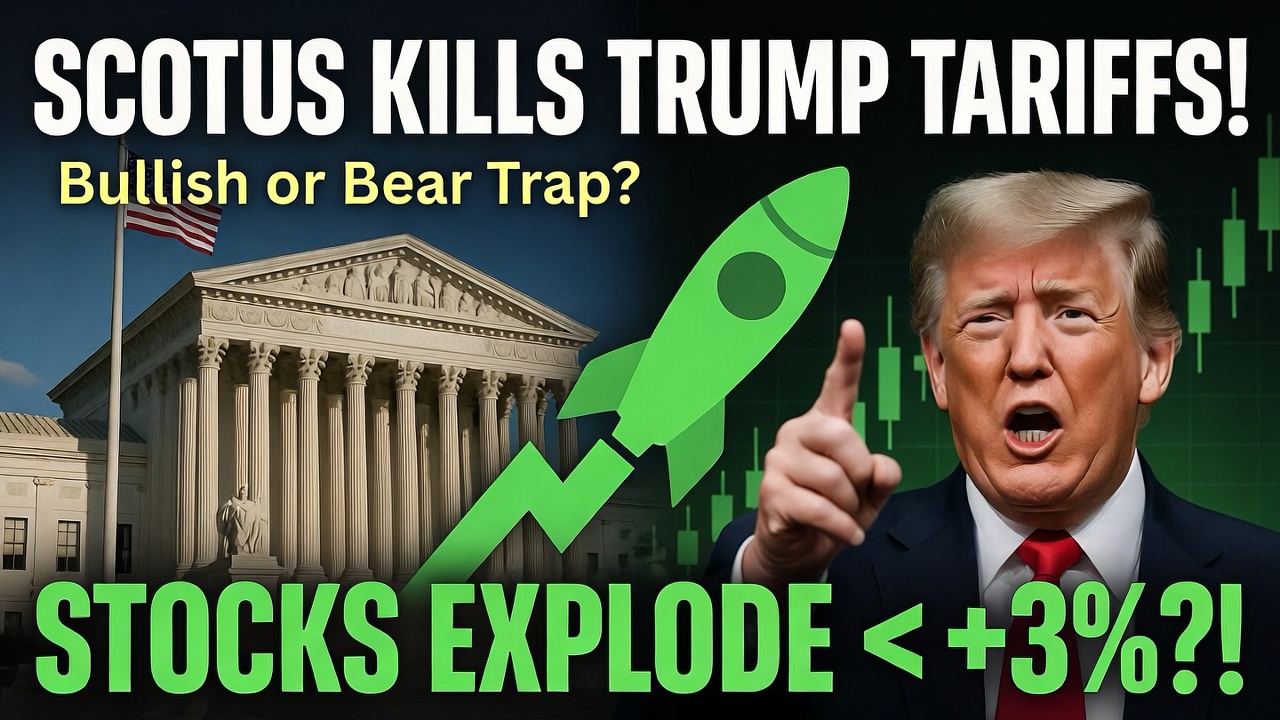
The market just received a massive jolt.
Today, February 20, 2026, the Supreme Court dropped a legal bombshell that sent immediate shockwaves through the financial markets. In a landmark 6-3 ruling, SCOTUS officially struck down President Trump’s sweeping global tariffs, declaring that the President exceeded his authority.
If you’re a trader, you know that policy shifts of this magnitude are where fortunes are made—and lost. Within minutes of the news breaking, the major indices spiked, specific sectors went vertical, and Financial X (formerly Twitter) exploded into a war of words between perma-bulls and skeptical bears.
But what does this mean for your portfolio? Is this the catalyst for a massive risk-on rally, or a bull trap setting up a bloody Monday reversal?
In this breakdown, we are going to unpack exactly what happened, who the biggest sector winners and losers are, what the top traders are saying, and most importantly, a step-by-step trading strategy you can use to capitalize on the fallout.
Let’s dive in.
🏛️ What Actually Happened? The SCOTUS Ruling Explained
To trade the news, you have to understand the news. Here is the short version of why the Supreme Court stepped in:
- The Overreach: Since April 2025, the Trump administration has used the International Emergency Economic Powers Act (IEEPA) to bypass Congress and slap 10%+ blanket tariffs on nearly every major U.S. trading partner.
- The Ruling: The Supreme Court ruled 6-3 that using emergency powers for blanket global tariffs without Congressional approval is illegal.
- The Financial Impact: These tariffs collected an estimated $175 billion to $200+ billion. Because the courts ruled them illegal, there is now a massive, looming question about potential refunds for the importers who paid them.
For the market, this ruling ends the era of the “Liberation Day” duties. The immediate removal of these trade barriers fundamentally alters the cost of doing business for thousands of publicly traded companies overnight.
📈 The Immediate Market Reaction: A Bullish Pop
The stock market hates one thing above all else: uncertainty. When the ruling crossed the wire, the market instantly interpreted the removal of trade friction as a massive green light.
The Intraday Numbers:
- S&P 500: Rallied +0.3% to +0.6% on the news.
- Nasdaq: Led the charge, jumping +0.4% to +1.0%.
- Dow Jones: Edged up +0.07% to +0.3%.
The real story, however, was in the individual sectors. Import-heavy businesses that have been getting squeezed by these tariffs suddenly saw their profit margins expand in real-time. Retailers, apparel brands, and auto manufacturers caught aggressive bids. Nike ($NKE) spiked 3%, and Macy’s ($M) jumped 2% in the immediate aftermath. European and Asian exporters saw similar relief rallies.
🐂 The Bull Case: Why Freer Trade is Fueling the Rally
If you look at the timeline on X right now, the bulls are spamming rocket emojis. But it’s not just blind hype; there is a very solid macroeconomic foundation for this rally:
- Lower Import Costs = Higher Corporate Profits: For the last year, tech companies, retailers, and consumer goods brands have had to eat the cost of these tariffs or pass them onto consumers (fueling inflation). Removing the tariffs instantly lowers cost of goods sold (COGS) and boosts earnings per share (EPS).
- The $200 Billion Stimulus: If the government is forced to refund the $175B–$200B collected from these illegal tariffs, that money goes straight back onto corporate balance sheets. This acts as a massive, unexpected economic stimulus that companies can use for stock buybacks, dividends, or reinvestment.
- Reduced Trade Friction: Freer trade usually wins for equities in the short-to-medium term. Supply chains can normalize, and the threat of retaliatory tariffs from other countries diminishes.
“Markets likely gon read this as BULLISH. Lower trade friction → stronger risk sentiment 📈” — @BREAKOUTgOD on X
🐻 The Bear Case: Why Contrarians Are Loading Puts
Trading isn’t a one-way street, and not everyone is celebrating. The contrarian bears are quietly loading up on put options, anticipating a “buy the rumor, sell the news” scenario that reverses by Monday. Here is what they are looking at:
- Domestic Producers Lose Their Shield: American steel, aluminum, and certain domestic manufacturing sectors just lost a massive competitive advantage. Without the tariff shield, cheaper foreign goods will flood the market, hurting these domestic stocks.
- The Fiscal Black Hole: The U.S. government was relying on that tariff revenue. Losing it—and potentially having to refund hundreds of billions—creates massive fiscal pressure. How does the government fill that hole? Likely through new taxes or increased borrowing, neither of which the market likes.
- Plan B Uncertainty: The Trump administration is not going to just roll over. The bears believe the administration will immediately pivot to using Section 232 (National Security) or Section 301 tariffs to accomplish the same goal legally. If that happens, the uncertainty returns instantly.
“Market won’t even last through close.. -2% Monday. Loaded puts 🩸. Trump Plan B usually worse.” — Bearish Trader on X
🏆 Sector Breakdown: Who Wins and Who Loses?
To trade this properly, you need to know where the money is flowing to, and where it is flowing from.
| The Winners (Bullish Focus) | The Losers (Bearish Focus) |
| Retailers: Macy’s ($M), Target ($TGT) | Domestic Steel: U.S. Steel ($X), Nucor ($NUE) |
| Apparel: Nike ($NKE), Ralph Lauren ($RL) | Aluminum Producers: Alcoa ($AA) |
| Autos & Tech: Import-heavy supply chains | Protected Manufacturing: Domestic factory stocks |
| Logistics: FedEx ($FDX), UPS ($UPS) | Government Bond Yields: On rising debt fears |
⚙️ The TSG Strategy: How to Trade the “Tariff Relief Rally”
At Trading Strategy Guides, we don’t just give you the news; we give you the setup. Because this news heavily impacts consumer cyclicals, we are going to look at a breakout strategy for the retail sector.
Here is the Tariff Relief Gap & Go Strategy:
The Setup:
- Asset: Retail or Apparel Stocks (e.g., $NKE, $M) or the Consumer Discretionary ETF ($XLY).
- Timeframe: 15-Minute or 1-Hour Chart (for Day/Swing traders).
- Indicators Needed: 20-period Exponential Moving Average (EMA) and Volume.
The Rules:
- The Entry: Wait for the first 1-hour candle to close after the news breaks. You want to see a strong, bullish green candle with trading volume that is at least 1.5x the average. Enter long when the price breaks the high of that first 1-hour “news candle.”
- The Stop Loss: Place your stop loss slightly below the 20 EMA on your chosen timeframe, or just below the low of the initial news breakout candle. News events are volatile; if the price drops below the initial reaction level, the bulls have lost control and the narrative is dead. Cut the trade immediately.
- The Take Profit: Scale out of your position. Take 50% of your profits when you achieve a 1:2 Risk/Reward ratio. Move your stop loss to breakeven on the remaining 50%, and let it ride using the 20 EMA as a trailing stop to catch any extended momentum going into next week.
Disclaimer: Trading news events carries high risk. The market can be highly irrational. Always adhere strictly to your stop loss.
The Bottom Line
The Supreme Court striking down these tariffs is undeniably a net-bullish event for the broader market today. Cheaper import costs and clarity usually beat uncertainty, giving stocks the green light to push higher.
However, the geopolitical landscape moves fast. Enjoy the short-term relief rally, but keep a very close eye on Monday’s open to see if the momentum holds, or if fears of “Plan B” tariffs drag the market back down.
Now, I want to hear from you!
Are you treating this SCOTUS ruling as a bullish rocket ship, or are you betting on a bearish pullback?
We also just posted a video on this! You can watch it here on YouTube


