



The internet presents itself as free. We search, scroll, message, stream, shop, post, upload, prompt, and click without reaching for our credit cards. It seems a simple and sweet deal: we get access to huge digital services, and in return, they get eyeballs, activity, and scale. But this arrangement was never really free
To examine just how unfree it is, the Web3 Foundation has today published The Hidden Price of Free: What Your Data Is Really Worth, a new White Paper that examines the commercial value generated by personal data across the Big Tech and AI economy. Its central finding is unambiguous: personal data is not a marginal by-product of the internet. It, and the financial value that can be derived from your data, is the financial heart that drives the digital age.
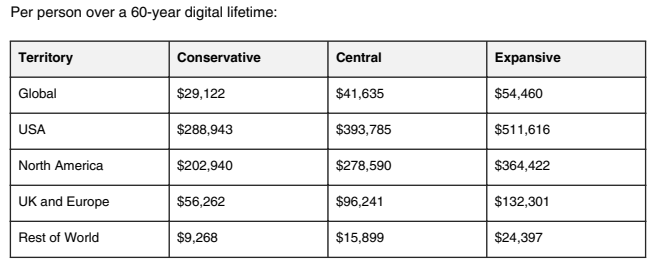
We found that Big Tech and AI companies earn upto $162,492 in inflation-linked commercial value from each internet user worldwide over a digital lifetime. Across the world’s estimated six billion internet users, that upper lifetime estimate would amount to approximately $745 trillion in commercial value.
The study calculated that the companies earn up to $8,500 per year from USA internet users, up to $2,206 per user in the United Kingdom and Europe, and $407 in the rest of the world. Globally, this amounts to up to $908 per internet user annually.
Over a lifetime, that means the commercial value for a user in the USA is $511,869, UK and Europe $132,387, $24,424 in the rest of the world, and overall $54,499 globally — or a huge $1.08m in the USA, $260,542 in the UK and Europe, $72,821 elsewhere, and $162,492 globally when inflation-linked.
Source: https://web3.foundation/hidden-price-of-free/web3-foundation-hidden-price-of-free-white-paper.pdf
These are not small sums or some sort of accountancy rounding figure. They are household-asset scale amounts of value.
In relative terms, the lifetime figure in Europe is equivalent to almost five years of full-time employment in the UK, using the ONS 2025 benchmark of $52,474 per annum. On an inflation-linked basis, the US lifetime figure of $831,301 is roughly equivalent to two times the Q1 2026 median sales price of a new US house. Amazon, Alphabet (Google), Anthropic, Microsoft, and Meta are explicitly listed in the report, each earning up to $1,000 annually from a single internet user.
Unlike previous attempts to estimate the value of personal data, which have focused mainly on advertising revenue per active user, our methodology takes a broader view of how human data is monetised in the modern digital economy.
The White Paper introduces a benchmark called Personal Data Annual Value, or PDAV, which looks across a wider modern data economy. That includes advertising platforms, AI subscription businesses, API providers, enterprise software, data brokers, marketplaces, algorithmic recommendations, hardware-linked ecosystems, and AI-driven cost savings.
This matters because the internet has changed.
Personal data is no longer used only to target adverts. It is used to train models, improve recommendations, build behavioural profiles, power enterprise systems, price risk, create predictive products, and generate new forms of machine intelligence. Every search query, uploaded image, chatbot prompt, location signal, purchase, message, or correction to an AI output can become part of a much wider commercial system. The more capable AI becomes, the more valuable human-origin data becomes.
Yet users remain largely excluded from the economic upside. They often have little visibility over how their data is collected, little practical bargaining power over how it is used, and little meaningful participation in the value it creates. Privacy notices and cookie banners may provide a formal layer of consent, but few people can realistically understand the full commercial life of their data across platforms, brokers, model developers, and enterprise systems.
That is the imbalance this report seeks to make visible.
The White Paper does not argue that every person is owed a precise cash sum. Nor does it claim that PDAV is a direct entitlement or invoice. It is a benchmark. It is designed to show the scale of commercial value associated with personal data and to open a more serious public conversation about ownership, control, transparency, and participation in the data economy.
The report also shows why our understanding of “Big Data” must widen. The companies benefiting from personal data are not only the familiar social media and search giants. The study assessed 129 qualifying companies across AI-first subscription and API businesses, ad-funded platforms, hardware-linked ecosystems, and data brokers. The data economy now extends into many more sectors, including finance, health, insurance, enterprise software, and infrastructure.
This is why Web3 matters. Its purpose is not simply to create new financial tools or speculative digital assets. Its deeper promise is architectural. Web3 offers the possibility of an internet in which identity, permissions, data access, digital assets, and online interactions are not entirely controlled by centralised platforms. It points towards systems where users can decide what they share, with whom, and on what terms.
A more equitable internet will require stronger user agency, clearer consent, better data portability, greater transparency, and new mechanisms through which people can control, protect, or share in the value their data creates. It will require technologies that allow users to verify, interact, and participate without handing over unnecessary personal information to closed platforms. It will require a shift from passive data extraction towards active digital ownership.
The purpose of this White Paper is to raise the question: if human data now creates extraordinary commercial value, why should the humans who create it remain the least powerful participants in the system?
The next phase of the internet’s development should not be about making extraction more efficient. It should be about building digital infrastructure that gives people greater control over their identity, their data, their assets, and their economic participation.
The reality is that, for the internet, free was never really free. But there is no reason it should not be fair in the future.
The Hidden Price of Free: Why Your Data is Worth Far More Than You Think was originally published in Web3 Foundation on Medium, where people are continuing the conversation by highlighting and responding to this story.


